

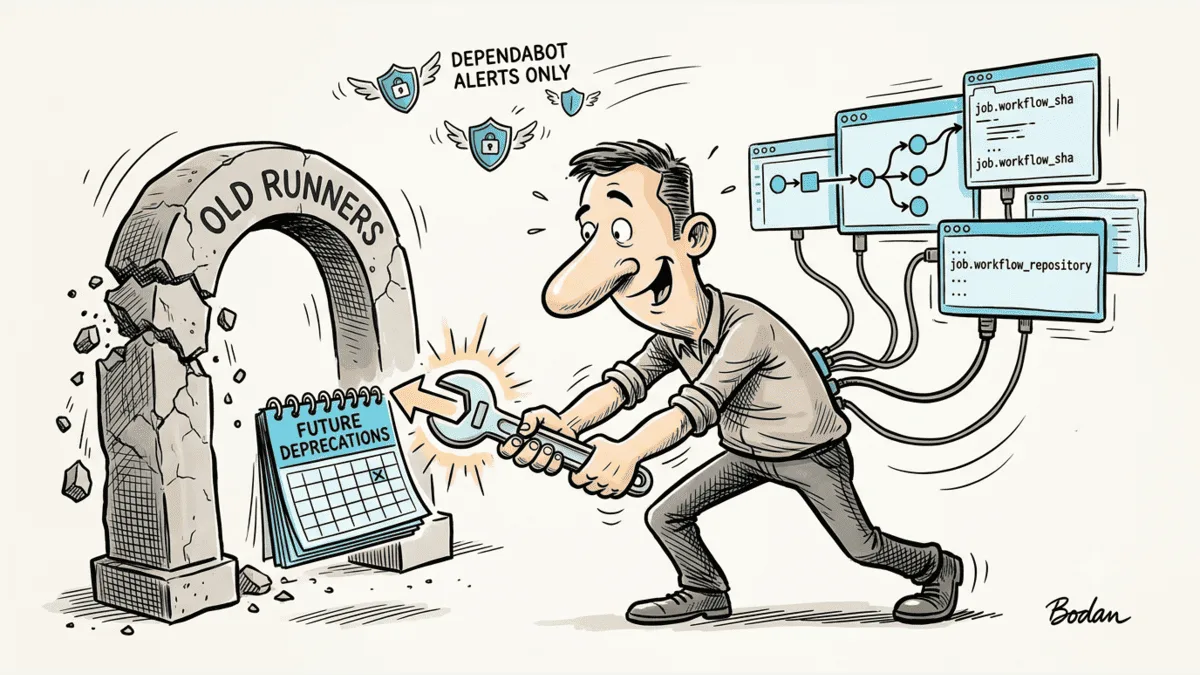
GitHub Actions Gives Teams More Ways to Get Ahead of Infrastructure Problems#
Keeping GitHub Actions runners up to date often becomes urgent only when a version starts causing trouble or approaches the end of its support window. GitHub is trying to make that process less reactive with a new REST API that lets teams programmatically determine when registration and runtime support will end for a specific runner version.
The GET /actions/runners/deprecations/{version} endpoint exposes fields including runtime_deprecates_at and registration_deprecates_at. For DevOps and platform teams, that means runner deprecation dates can become part of maintenance workflows, internal alerts, or upgrade planning instead of being discovered late in the lifecycle.
The significance is less about adding another API and more about turning deprecation into a signal that can be automated. In environments where CI/CD pipelines support critical workloads, that visibility can make runner upgrades easier to plan before unsupported versions become an operational concern.
Tighter Dependabot Access With GITHUB_TOKEN#
GitHub is also making GITHUB_TOKEN permissions more granular. The new vulnerability-alerts permission provides read-only access to Dependabot alerts, allowing workflows to retrieve vulnerability information without relying on broader permissions.
The permission supports read and none, a relatively small change that maps directly to the principle of least privilege: workflows should receive only the capabilities they actually need.
That distinction matters in repositories where multiple automations interact with sensitive information. Narrowing token permissions does not remove the risks of a compromised credential or a misconfigured workflow, but it can reduce the amount of access available to jobs whose only requirement is reading vulnerability alerts.
Reusable Workflows Get Better Traceability#
The third update addresses a recurring problem in CI/CD environments that rely heavily on shared workflows: identifying exactly which workflow code ran.
GitHub has added four properties to the job context: job.workflow_ref, job.workflow_sha, job.workflow_repository, and job.workflow_file_path. Together, they provide more precise information about the workflow that actually defines the running job, particularly when reusable workflows are called across repositories, branches, or references.
job.workflow_sha, for example, can identify the exact commit used during a run, while job.workflow_repository and job.workflow_file_path help locate the workflow within shared automation infrastructure.
For organizations that centralize pipelines, that extra context can improve deployment traceability and incident investigation. Linking a run to a specific workflow revision makes it easier to determine what changed and which automation code was active at a given point in time.
Conclusion#
None of these GitHub Actions changes is a major platform overhaul on its own, but together they address three recurring concerns in mature CI/CD environments: maintenance, permissions, and traceability. The runner deprecation API gives teams earlier visibility into upgrade deadlines, vulnerability-alerts narrows access to Dependabot data, and the new job properties provide more context for reusable workflows. Their practical value will depend on how teams integrate them into existing processes, but collectively they provide better signals for operating pipelines with less reliance on reactive maintenance and with stronger auditing capabilities.
Original source: Github Changelog