
Enterprise AI Growth Does Not Guarantee a Durable Moat#
Enterprise spending on artificial intelligence continues to rise, but turning that demand into predictable recurring revenue is proving to be a different challenge. IDC puts the global IT market at roughly $4.2 trillion, while a Madrona survey of 150 senior enterprise decision-makers found that 74% expect to increase AI budgets over the next 12 months. The money is moving in; the harder question is how long it stays with the same vendor.
For AI startups, that distinction cuts into one of enterprise software’s traditional advantages. SaaS built much of its predictability around recurring contracts, deep integrations, and meaningful switching costs. In AI, Madrona describes a market where buying cycles are getting faster while vendors remain under continuous evaluation.
The Gap Between Pilots and Production Remains#
Higher budgets do not automatically translate into scaled deployments. According to Madrona, 83% of surveyed enterprises moved fewer than half of their AI pilots into production over the previous year. That suggests a significant share of AI spending still has to cross the gap between experimentation and sustained operational use.
MIT NANDA’s 2025 research provides additional context. Its study found that 95% of the enterprise generative AI initiatives it examined showed no measurable financial impact. The methodologies are different, so the figures should not be treated as a direct year-over-year comparison, but they point toward the same underlying challenge: adopting AI is considerably easier than producing repeatable economic value from it.
“Fast In, Fast Out” Changes the ARR Equation#
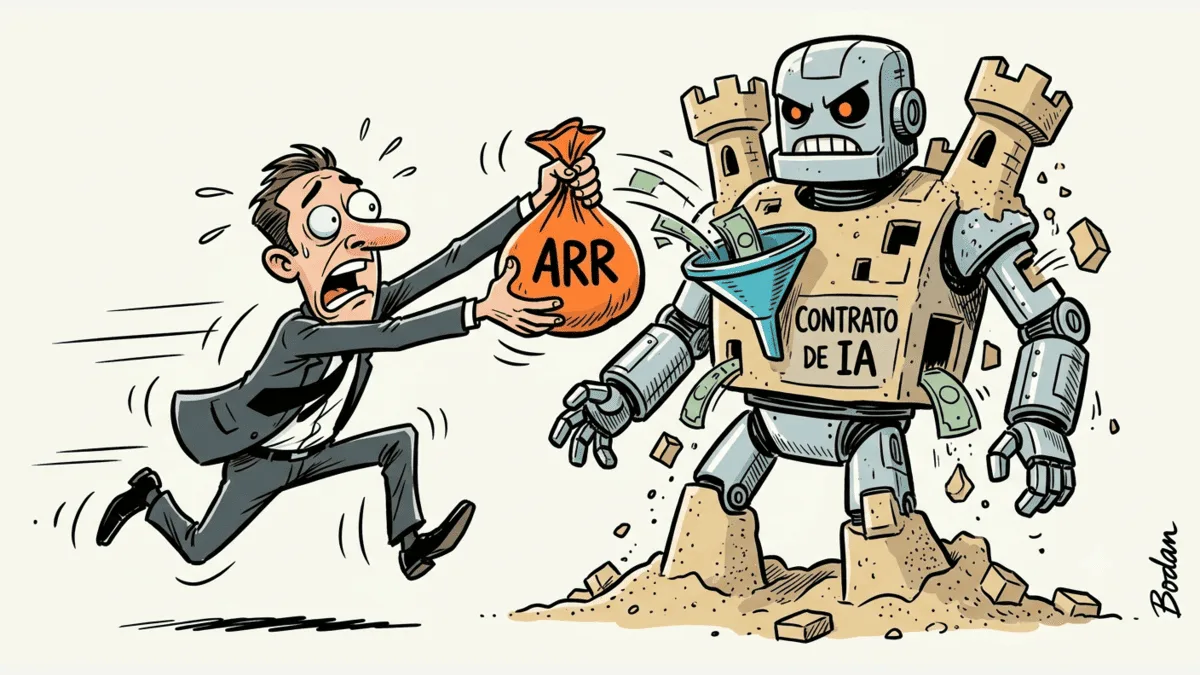
The more consequential number for vendors may be on the renewal side. Madrona found that 77% of enterprises reevaluate their AI vendors at least every six months, with 29% doing so on a rolling basis. At the same time, 52% of AI deals close in less than six months. Madrona describes the pattern as “fast in, fast out.”
For a startup, landing the account is therefore only part of the job. The pressure shifts toward proving value through every reevaluation cycle. Lower switching costs and a rapidly changing vendor landscape can make ARR less defensible than in SaaS categories where replacing an incumbent carries more operational friction.
Pricing Is Moving Closer to Work Delivered#
The commercial model is evolving alongside procurement. In a recent Andreessen Horowitz survey of 50 technical AI buyers, 27 preferred credits tied to recognizable units of work, compared with 14 who preferred token-based pricing. a16z argues that when value can be reliably measured and attributed, pricing should move closer to the work or outcome delivered rather than the underlying compute consumed.
Conclusion#
The enterprise AI opportunity continues to expand, but growing budgets and durable vendor revenue are not the same thing. Pilots still struggle to reach production, buyers reevaluate tools frequently, and pricing is beginning to shift toward recognizable work and measurable outcomes. For startups, the main constraint on the traditional SaaS model may be the lack of customer inertia: fast adoption does not necessarily produce defensible ARR. Building a durable moat will increasingly depend on continuous value, deep integration, and results that remain difficult for customers to replace when the next evaluation cycle arrives.
Original source: techcr